Showing posts with label megan rosburg. Show all posts

Wednesday, October 26, 2011

Ford Up in Revenue, Down in Earnings


        Ford Motor Co. has seen a sudden 2% drop in earnings, even though its revenue has increased by 14% (1). Revenue is the value of what a firm received for goods sold, services performed, and other additional payments received.  If their revenue escalated by such a large amount than why is Ford seeing a drop in earnings?
            This question is answered by simple accounting equations such as net income or net loss. Subtracting the total cost of goods sold and operating expenses from the total revenue gathered throughout the quarter calculate these losses or gains. What Ford endured was a sudden increase in the cost for commodities, materials, warranty and freight costs (1). This cost increased by more than $1 billion in comparison to the previous quarter (1). Ford Chief Financial Officer Lewis Both said “the commodity costs caused Ford to lower its estimate for automotive operating margins to 5.7% from 6.5% for the full year” (1).
           To account for this decrease, Ford is also planning on lowering its capital spending to $4.6 billion down to $5-$5.5 billion (1). Mr. Booth said that Ford will restore the dividend, which has been gone since 2006, “as soon as our balance sheet can stand it” (1). Ford will continue to lower its company’s debt, which sits at $12.7 billion but was once at $33 billion in 2009 and is expecting industry sales to be higher than its previous quarters this year (1).

Sources
(1)http://online.wsj.com/article/SB10001424052970203687504576654740804146776.html#articleTabs%3Darticle
(Image) http://smallbiztrends.com/wp-content/uploads/2009/09/reduce-boost-graph.jpg
Sunday, October 16, 2011

Foreign Auto Companies


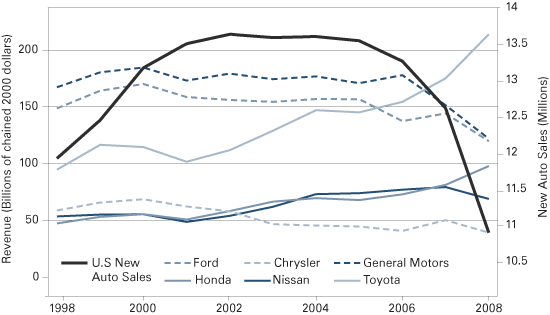
According to this graph, it shows a clear downhill trend in the top revenues for the “Big Three” between the years 2005-2008 (1). The Japanese automakers however saw tremendous success. As a result, revenues for the GM, Ford, and Chrysler are all significantly lower in 2008 compared to what they were ten years ago (1). Economists noted that, “General Motors shifted from being the highest revenue earner at $167 billion in 1998 and a high of $184 billion in 2000 to drop down to $122 billion in revenue in 2008—a distant second among automakers” (1). However, all three major Japanese automakers saw their revenues expand over this period with Toyota increasing its revenues from “under $100 billion in 1998—a distant third in ranking—to an astounding record $214 billion in 2008” (1).Toyota is now the largest automaker in the world and their constant annual growth of 8 percent in this period seems to show that they were the biggest reason of the decline of the American carmakers. (1)

These foreign-owned companies such as Kia, Mercedes, Toyota, Nissan, and Suzuki have actually been somewhat beneficial to particular southern areas in the United States. Two-thirds of "foreign imports" are, in fact, built in the United States in nonunion shops, where it costs at least $2,000 less in labor to build each vehicle (2).
Americans claim that the Japanese, Korean, and German auto companies are taking advantage of desperate communities in the South. But among people in West Point, Ga. disagree.
"Workers [in the South] understand that in order for them to have a job these companies have got to make money, because if they don't, they're not going to have a job," says Rep. Lynn Westermoreland "That's the first issue [Detroit auto executives] need to address before they come to Congress asking for a bailout or a loan or whatever it is," she says in a phone interview (2). Around the South and especially here on Interstate 85 – nicknamed the "autobahn" for the prevalence of foreign-owned car plants along its stretch – the manufacture of foreign vehicles has jumped 450 percent since 1986 (2). While the Big Three have lost more than 600,000 jobs since 1980, foreign automakers have created about 35,000 jobs in the same amount of time (2).

Sources
(1)http://www.ibrc.indiana.edu/ibr/2010/spring/article2.html
(2)http://www.csmonitor.com/Business/2008/1205/p01s04-usec.html
(Image) http://www.ibrc.indiana.edu/ibr/2010/spring/article2.html

Sunday, October 9, 2011

Big Three


       When it comes to automakers in the United States, one term that will be consistently brought up is the term  “Big Three”.  The “Big Three” consists of the auto companies Ford, General Motors, and Chrysler.  Other than producing the most vehicles in Northern America, these three automakers have a huge influence on the overall economy. Because they are huge employers, the economy will grow due to their high union wages and benefit packages.

            The Big Three have been hurt from perceived poorer quality and reliability compared to their Japanese competitors. They have also been slow to bring new vehicles to the market, while the Japanese are considered the leaders in productivity and introduction to more sustainable cars (1). Falling sales and market share have resulted in the Big Three's plants operating below capacity, which lead to production cuts, plant closures and layoffs (1). They have had to rely solely on offering high buyer incentives and subsidized leases to sell vehicles. These desperate actions drove down a significant portion of the Michigan economy (1). CBC News explains, “Promotional strategies, including rebates, employee pricing and 0% financing, have boosted sales but have also cut into profits.” (1)

            In the 1990s, North American automakers made a big commitment to large sport utility vehicles (1). For a while, that was the segment that was selling. SUV sales peaked in 1999 and have been declining ever since (2). The gasoline price spiked hurt sales of SUVs even more, which only continued into April 2008. Sales of trucks dropped 17 per cent while sales of large SUVs suffered by 29 per cent (2). The Big Three’s primary product is now being overshadowed by Toyota’s and other automakers’ econ-friendly small and compact cars that have a much higher gas mileage. As stated in the CBC News, “New products, more efficient plants, fewer employees, renegotiated contracts and government loans may help the Big Three succeed.” (1)
 Sources
(1) http://www.cbc.ca/news/business/story/2009/02/17/f-bigthreeupdate.html
(2) http://www.washingtonpost.com/wp-dyn/content/article/2009/01/09/AR2009010903657.html
(Image) http://blogs.dailypennsylvanian.com/thebottomline/files/2009/03/detroit_3.jpg

Sunday, September 25, 2011

Corporate Social Responsibility


Corporate social responsibility is a term that acts as a moral monitor for businesses to keep themselves accountable. It covers the companies conformity to obey the law and high ethical standards that are set by the consumers. Active CSR companies would emphasize its positive involvement with the community, environment, employees, and customers.

Several companies, including Toyota, are promoting their CSR through the research and development of environment-friendly cars. Toyota has stated in their 2011 Corporate Social Responsibility Report that they are “directing their efforts into creating plants which harmonize with nature and coexist with our communities in progressing to reduce CO2  and save energy during production.” (1) Not only is Toyota one of the top leading sellers in the Hybrid car product line, but now they are currently aiming to develop production facilities and machinery that will have less harm to the communities and environments that surround them.

Toyota has also released statements that mention their contributions to the damaged areas from the 2011 Japanese earthquake and made it a priority on resuming production of supply parts for vehicles in need of repair used in recovery efforts and the disaster area. (1) Toyota Auto Body also donated 100 million yen to disaster relief efforts, and then from the collected contributions donated six vehicles. (1) On top of these offerings, Toyota also sent drinking water, food, and other living necessities to the victims of the disaster-stricken Japanese land. (1) They claim that “Industry is said to be a public institution of our society.” (1) Toyota Auto Body provides a useful service in society, and makes an effort to provide vehicles which meet the average customer’s expectations, as well as those of the elderly, the handicapped, and customers throughout the world “in looking to continue as a corporation needed by society”. (1)


Sources
(1) http://www.toyota-body.co.jp/english/csr/index.html
(Image) https://blogger.googleusercontent.com/img/b/R29vZ2xl/AVvXsEiQfk_uo3pdfAB0OS6B0g-1jiv5x65tK0to65r6tuIo14h9F48U1whHccDih1Cc-1it2gcbqF3NNnU644wXswbVIoxl7HlID94InK-_n6Ko9PNx3S6FP0Ey0kxZnMeYwxaeETxuxfz0_epy/s1600/toyota.jpg

Sunday, September 18, 2011

Supply and Demand of the Auto Industry

Like all other industries, the auto industry can be illustrated by basic macroeconomics. If there is a low demand, then the purchase price will decrease. On the contrary, if the demand exceeds the supply of the vehicles on site, then the price can have a sudden increase. The manufacturer controls and oversees the inventory that is shipped out to the dealers (1). The price of cars will also increase in the buyers' incomes enlarge. Automobiles are considered a normal good, therefore if average income rises, so would the demand, supply, and price of cars (2). 


Gasoline, a strong complement of automobiles, will always continue to have a steady effect on the demand curve (2). As the price of gas has risen, the demand for smaller and more fuel efficent cars has increased exponentially. The market for SUV's has decreased, therefore Toyota reacted by raising the price and production of its Pruis hybrid cars (3). In just two years (2005-2007) Toyota doubled its production rate of Prius cars, all because of simple supply and demand economics.

Sources

Share

Twitter Delicious Facebook Digg Stumbleupon Favorites More